News announcement from Office of the Mayor on HALA today

city of seattle logoAgreement will bring Affordable Housing to Neighborhoods Across Seattle

Mayor Ed Murray and Councilmember Mike O’Brien today hailed an unprecedented agreement that will lead to at least 50,000 new homes in Seattle, including 20,000 affordable homes, over the next 10 years. Affordable housing will be included in nearly every residential development across Seattle as the rate of construction of new affordable homes triples.

“As Seattle expands and experiences rapid economic growth, more people are chasing a limited supply of housing. We are facing our worst housing affordability crisis in decades,” said Mayor Ed Murray. “My vision is a city where people who work in Seattle can afford to live here. Housing affordability is just one building block to a more equitable city. It goes hand in hand with our efforts on raising the minimum wage, providing preschool education for low-income children, and increasing access to parks and transit. We all share a responsibility in making Seattle affordable. Together, this plan will take us there.”

“Since 2013, the City Council has called for a robust, citywide, mandatory affordable housing program to help ensure that the people who work in this city can afford to live here. The combination of Mandatory Inclusionary Housing and a Commercial Linkage Fee will ensure that as Seattle continues to grow, we are creating housing for all incomes,” said Councilmember Mike O’Brien.

At the heart of the action plan to make Seattle affordable is Mandatory Inclusionary Housing, a requirement that developers reserve five to seven percent of units in every new multifamily building to be affordable for residents earning up to 60 percent of King County’s Area Median Income (AMI). Developers could opt to contribute to a fund for off-site construction of the units.

In 2015, 60 percent of AMI is $37,680 for an individual and $53,760 for a family of four. Current market-rate rents in new buildings on Seattle’s Capitol Hill currently average $1,887. In 2015, individuals with incomes of 60 percent of AMI pay $1,008 for income-restricted apartments.

New buildings will have taller height restrictions in existing multifamily residential, mixed-use and commercial zones throughout the city. A substantial portion of the additional development will occur within the existing Urban Centers and Urban Villages, designated two decades ago as the preferred location for denser housing. Only single-family zoning within Urban Villages and along major arterials will be converted to low-rise residential.

A map of the proposal, which was negotiated by Murray, O’Brien, developers and affordable housing advocates, shows where the growth could occur.

The action plan also includes a Commercial Linkage Fee on new commercial development, phased in over three years, to fund additional affordable housing for the lowest-income families. The linkage fee will range from $5 to $14 per square foot, based on the size and location of the commercial development.

When fully implemented, Mandatory Inclusionary Housing and the Commercial Linkage Fee will lead to the construction of at least 6,000 new affordable homes over 10 years.

The Housing Affordability and Livability Agenda (HALA) advisory committee today delivered to the mayor 65 recommendations after 10 months of work. The consensus-driven proposal was crafted by a 28-member committee of affordable housing advocates, community voices, developers and housing experts appointed by the mayor and Seattle City Council last September.

“Many thanks to all the committee members and staff for an extraordinary amount of work over the past 10 months,” said HALA co-chairs David Wertheimer and Faith Li Pettis.  “We were asked by the mayor and council to offer bold, new concepts in our approach to solving the affordable housing crisis. We think this plan fully delivers on that request.  We were able to complete our task because we approached the challenge with a single, shared goal: to make Seattle affordable for all families. None of us got exactly the solution we may have envisioned at the outset, and every one of us had to give a little to reach this landmark agreement. In the end, we are confident that our collaboration will result in thousands of new affordable homes across our city.”

Murray immediately responded to the recommendations with his roadmap to make Seattle affordable, a path to reach his goal of 50,000 new homes, including 20,000 new homes for low- and moderate-income people, over the next decade. Some items in the action plan could be completed this year, while others will require at least two years to implement. In the coming weeks, the mayor will transmit to council a resolution to formalize the elements and framework of the Mandatory Inclusionary Housing program.

Today, about 45,000 households in Seattle spend more than half their incomes on housing. An estimated 2,800 people sleep outside each night in Seattle. Currently, about 700 income-restricted homes are built in Seattle each year.

The increased development capacity across the city will ensure increase supply of housing to respond to growing demand, as Seattle is forecast to add 120,000 residents over the next 20 years.

Single-family zones currently represent 65 percent of all land in Seattle. After the proposed zoning changes, single-family zones will still cover 61 percent of Seattle. HALA proposes code changes that will make it easier to build accessory dwelling units and backyard cottages (only one percent of homeowners have done so), as well as allow duplexes and triplexes, while preserving the character of single-family neighborhoods.

Residential development continues to be excluded from industrial areas under the proposal.

The City is currently engaged in a community process to update its Comprehensive Plan, called Seattle 2035. Over the past two decades, the Comprehensive Plan has been successful in locating 75 percent of Seattle’s new housing in Urban Centers and Urban Villages. The update, to be completed in 2016, contemplates expansion of Urban Villages and denser housing around transit hubs and light rail stations. HALA’s recommendations will be implemented in conjunction with the updated Comprehensive Plan.

Doubling of Housing Levy in 2016

To meet the needs of the Seattle’s lowest-income residents, those earning less than 30 percent of AMI, HALA also proposes to double the existing $145 million Seattle Housing Levy scheduled to expire in 2016. Over the past 30 years, the levy has funded $400 million to build and preserve nearly 12,000 units of affordable housing.

In 2015, 30 percent of AMI is $18,850 for an individual or $26,900 for a family of four.

This year, the City will award a record $42 million from the Housing Levy and the existing Incentive Zoning program for the development and preservation of low-income housing. The Seattle Office of Housing will issue project guidelines and invite partner applications later this week.

The HALA report also urges the Washington State Legislature to allow Seattle to adopt a 0.25 percent real estate excise tax dedicated to affordable housing development, as well as an increase in the State Housing Trust Fund.

To support moderate-income families, HALA recommends expanding the Multifamily Property Tax Exemption Program (MFTE) that is set to expire at the end of the year. Under MFTE, developers receive a tax exemption when they dedicate 20 percent of units in new buildings for moderate-income people, typically between 65 percent and 85 percent of AMI. HALA proposes to expand the program to all areas where multifamily housing can be built and incorporate a new incentive for three-bedroom units to extend program benefits to larger moderate-income families.

In 2015, 80 percent AMI is $46,100 for an individual and $65,800 for a family of four.

HALA recommends a range of tenant protections to ensure better access to housing, prevent housing discrimination and minimize displacement as rental and ownership costs increase across the city:

  • Prevent displacement as rents increase across the city through a Preservation Property Tax Exemption and other mechanisms.
  • Remove barriers to housing for renters with a criminal history that disproportionately impact people of color.
  • Strengthen the Tenant Relocation Assistance paid to low-income renters who are displaced by new development.
  • Develop new homeownership tools for Muslim buyers who cannot use conventional mortgage products due to their religious convictions.
  • Establish new protections to prevent discrimination against renters due to their source of income.

HALA also recommends that the City continue to review parking policies that contribute to the growth of housing costs or inhibit development in single- and multifamily residential zones.

– See more at: http://murray.seattle.gov/#sthash.PdVGC3xr.dpuf
Seattle 2035: Draft Plan Published

SEATTLE – Today, the Seattle Department of Planning and Development (DPD) released a Draft City of Seattle Comprehensive Plan.  Entitled Seattle 2035, the Draft Plan is now available for public comment.  This important milestone brings the City one step closer to completing an updated Comprehensive Plan – our roadmap for Seattle’s next 20 years.

The Draft Plan is informed by the Draft Environmental Impact Statement (DEIS) that was released in May 2015.  The Draft Plan identifies proposed goals and policies to help achieve our vision for Seattle’s future.  Seattle is expected to grow by 120,000 residents and 115,000 jobs in the coming twenty years.  The Draft Plan also includes a new Future Land Use Map, showing a pattern of growth that supports the City’s vision.

The City of Seattle is seeking public feedback on proposed goals and policies as we continue to evaluate strategies to build a safe, vibrant, affordable, interconnected, and innovative city for all.  City staff has already received hundreds of public comments on the DEIS and on the overall direction of the Plan document.

“The Comprehensive Plan is to be a plan for everyone,” said Diane Sugimura, Director of DPD.  “Seattle 2035 anticipates how Seattle may grow, and acknowledges that Seattle demographics, lifestyles, interests and needs are also changing.  The Plan seeks to balance our economic, social and environmental needs well into the future.  How can we address tomorrow’s issues, today – maintaining our rich cultural diversity in residents and businesses; ensuring our youth have jobs and a place to live; becoming a resilient city prepared for the future?  We want to hear from everyone about the directions identified in the Plan.” 

DPD is seeking public comments on the Draft Plan during a three-month public comment period, from July 8 through the end of September.

megaphoneHere’s how to join the discussion about Seattle’s future and provide comments:

  1. Check out seattle.gov to learn more about what’s in the Draft Plan and to read the executive summary
  1. Join the Seattle 2035 Online Community Conversation at seattle2035.consider.it and discuss the potential pros and cons of proposed policies with other Seattleites
  1. Attend our Draft Plan Public Event on September 15 – Stay tuned for more details
  1. Follow Seattle 2035 on Facebook and Twitter
  1. Send comments by the end of September:
    • Email: Send comments to 2035@seattle.gov
    • Mail: Send comments to the City of Seattle Department of Planning and Development, Attn: Seattle 2035, 700 5th Avenue, Suite 2000, PO Box 34019, Seattle WA 98124-4019.
    • In Person: Attend our Draft Plan Public Event on September 15. Stay tuned for more details!

Feedback received on the Draft Comprehensive Plan will help inform the Mayor’s Recommended Plan which will be released in late 2015

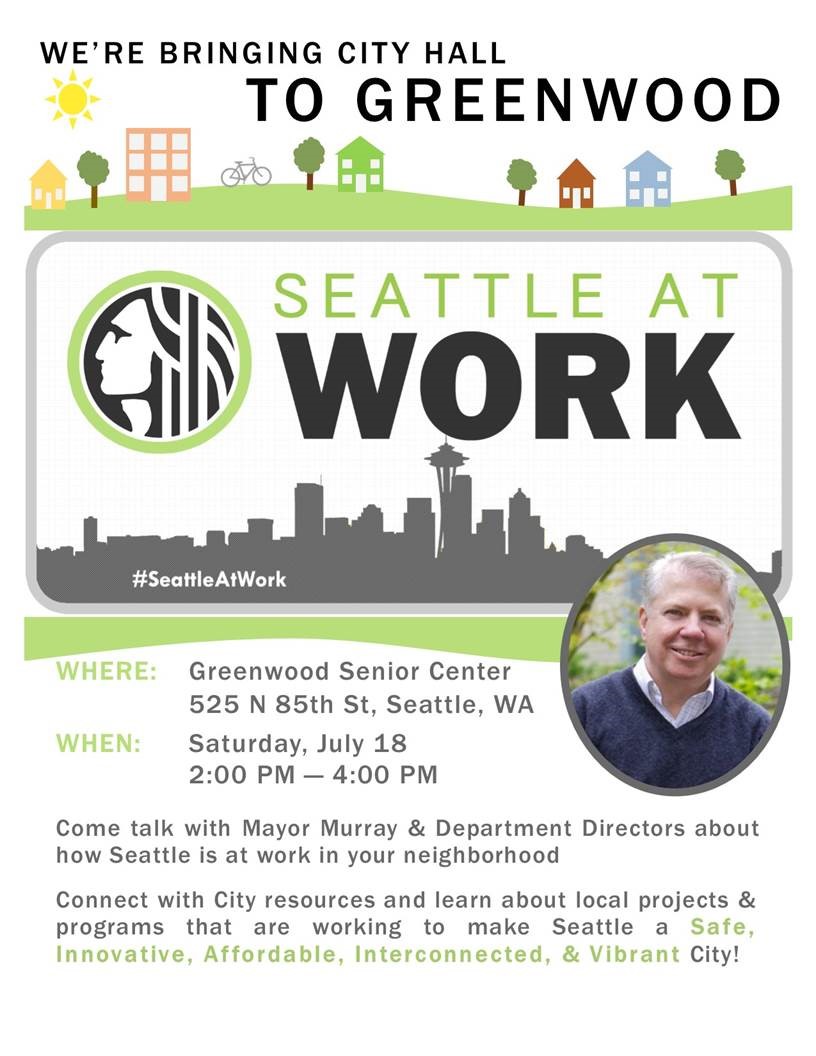
Mayor Murray is coming to Greenwood

Greenwood post


Here’s a great opportunity to talk with the Mayor and Department Directors about how the City of Seattle works in the Greenwood area.  The Mayor and Department Directors are planning Seattle at Work visits to other neighborhoods throughout the year.
Thanks to being able to work with community partners in the area, our Department of Information Technology has been able to support 10 community sites with public internet access and training in the area. The North Seattle Boys & Girls Club, The Greater Seattle Bureau of Fearless Ideas, and the United Indians of All Tribes Foundation Labateyah Youth Home have been able to help support digital equity with our Technology Matching Fund grants.

Broadview Charity Sale

Help support two local charities by stopping by the Armadillo 7th Annual Parking Lot Sale for Charity.  The event is Saturday, June 27 from 9 a.m. to 2 p.m.

Meet your neighbors, support two local charities, support a local business.   Here’s how it works:  sellers in the Armadillo parking lot donate 10% of their sales, and Armadillo Consignment matches those to support two local charities.  In years past, they have supported food banks, women’s causes and children’s health – all selected by the participants.  PLUS the store will be on sale for 20% off … during the sale hours only.

Armadillo is at 125th and Greenwood Ave. N. (12421 Greenwood Avenue North).

Participate in Night Out 2015 on August 4th

It’s time to start thinking about holding a Night Out block event.  Each year many groups of neighbors have a potluck get together to socialize and maybe talk about crime prevention.  This year’s Night Out is on Tuesday August 4.

“Night Out” is a national Crime Prevention event. Seattle has had a long history of supporting Night Out. The program has been growing every year, with over 1,400 neighborhoods participating each year. This type of community participation is what makes Seattle a great place to live.

The event is a unique opportunity to bring your neighbors together, welcome new neighbors, talk about crime prevention and Block Watch efforts, and mainly just have a great time with food, music, games – whatever you want. The creativity we’ve seen of what neighborhoods come up with is amazing. Some gatherings are just a few households; others expand into large block parties.

Information about how to invite your neighbors is here.

You can register your event here if you want to close off your street or invite Fire Department or Police Department staff to stop by.

The War on Density

There are many neighborhood concerns on growth in Seattle including Broadview.  I thought I would share an article written by Josh Feith published today in Publicola at SeattleMet.

 City Council Committee Restricts Density with Series of NIMBY Amendments | Seattle Politics | Seattle Met

Retiring city council member Tom Rasmussen—he’s not running for reelection in this year’s districted races—is evidently intent on going out in a blaze of antidevelopment glory. Already pushing blank-check “neighborhood conservation district” legislation to halt development in single-family zones, Rasmussen set out yesterday to make it more difficult for developers to build in multifamily zones—the stretches of apartment and townhomes in low-rise zones on the edges of single-family neighborhoods in places such as Capitol Hill and Ballard.
Rasmussen arrived at yesterday’s Planning, Land Use, and Sustainability Committee meeting with a series of amendments to PLUS committee chair Mike O’Brien’s low-rise legislation to ensure new housing would “fit better into neighborhoods,” Rasmussen said. City Council Committee Restricts Density with Series of NIMBY Amendments | Seattle Politics | Seattle Met

O’Brien introduced the original legislation, already an attempt to slow down growth and appease antsy neighbors, in late May. (O’Brien is running for reelection in District Six, which includes cozy single-family neighborhoods throughout Ballard.) But for Rasmussen and the neighbors who showed up yesterday to testify and support stricter rules, O’Brien’s legislation clearly didn’t go far enough. Roberta McKenna, a Greenwood resident referred to streets with low-rise apartment buildings as “canyons of darkness,” while a Ballard resident compared the neighborhood’s growth to “cancer”—likening stricter density regulations to necessary “chemotherapy.” Another speaker supporting Rasmussen’s amendments  said Seattle’s growth needed to be more “organic” as opposed to “Monsanto-ized.”
Rasmussen was not quite as over the top (frankly, it was hard to match the dramatic rhetoric coming from the audience), but he went for it all the same: “Developers will not give a damn about the quality of life of a person who lives next door,” he said.

With the consistent support of council member Jean Godden, who’s up for reelection in District Four (which stretches from the U District northeast to suburban Wedgwood and Sand Point), and retiring populist hero and council member Nick Licata, Rasmussen passed three of his eight amendments.
(One losing amendment—that only Godden supported—would have squashed, arguably the only urbanist aspect of O’Brien’s legislation, a green proposal to add superenvironmental passive houses to the list of developments that qualifies for square footage bonuses. It’s worth pointing out Godden’s support for Rasmussen’s oddball amendment—developments with fewer environmental bona fides currently get the bonuses—because there’s a potential passive house development in play in Godden’s district. Her young, urbanist opponents, Rob Johnson and Michael Maddux, have expressed support for the housing development.)

O’Brien voted no on all of Rasmussen’s amendments with consistent backing from urbanist Sally Bagshaw, up for reelection in District Seven, which includes downtown as well as single-family enclaves in Upper Queen Anne and Magnolia.

One of the amendments Rasmussen passed makes developers count exterior walkways, including the outdoor breezeways, as part of the square footage calculation, known as floor area ratio, or FAR; Rasmussen’s change would limit the amount of space developers can use to build units. New, temporary council member John Okamoto joined Rasmussen, Godden, and Licata on that one. Rasmussen also passed an amendment—with support from Godden and Licata again, along with Okamoto too—that would require spaces between row houses and adjoining lots.

The third amendment Rasmussen passed—with council president Burgess and Godden and Licata in his corner—was the most significant. It expanded O’Brien’s legislation, which already increases the rounding up threshold in the square footage calculation that allows developers to build an extra unit, by both raising the threshold and broadening the turf it covers. O’Brien’s legislation only governed low-rise one zones (mainly townhome development), while Rasmussen’s successful amendment extends it to low-rise two and three zones, which include apartment buildings. 

Several of Rasmussen’s other amendments to rein in low-rise development failed, though, including: one that would have penalized developers for interior loft development, or clerestories, in the density calculation, another that would have derailed basement apartments, and one that would have created new density limits on row houses. (Even Godden voted against the basement amendment, pointing out that basement apartments are a source of affordable housing; Licata sided with Rasmussen on the losing amendment.)

On top of the hissing that accompanied a string of Rasmussen defeats during the meeting, one livid attendee, who wanted council members to raise their hands during votes, shouted: “I thought you were going to [show] hands! We want to see who did this!”

There were some other people in the audience who (while not crazy about O’Brien’s original legislation themselves) liked Rasmussen’s even less. Scott Starr, an architect with SMR, a local company that frequently works with nonprofit low-income housing developers, urged the council not to take up the laundry list of amendments. “Even under the current zoning code, our nonprofit clients avoid low-rise zones. The density limits, parking requirements, and FAR limits make it impossible for them to develop affordable housing in these zones,” he said during public comment. “This locks out a large portion of the city’s land for nonprofit developers.”

Roger Valdez, director of Smart Growth Seattle, a pro-development lobbying group which has been adamantly opposed to the code changes since they were first introduced in 2014, said the PLUS committee “hedged its bets with neighborhood angst.” He concluded: “The problem is they [the committee] are bargaining away a known good—more housing—for vague benefits like a neighbor’s view of the sky.”

The amended legislation will go to full council in early July, where it will be interesting to see how antideveloper council member Kshama Sawant, who wasn’t at yesterday’s committee meeting, votes. The fate of Rasmussen’s amendments could be in her hands (along with council member Bruce Harrell, who also wasn’t on hand yesterday).

Will Sawant back Rasmussen’s extreme amendments (as we’ve noted, Sawant seems just as much about defending the sanctity of the 65 percent—the disproportionate amount of land that’s zoned single-family—as she is about fighting for the 99 percent, who need more affordable housing)? Or will she side with her lefty ally Mike O’Brien?

Let’s be honest, though: O’Brien’s original legislation, which already reins in multifamily development with limits on the size of top-floor development clerestories, tougher square footage guidelines, and stricter design review rules, is hardly pro-development.

Rasmussen framed his stand as a check on mayor Ed Murray’s Housing Affordability and Livability Agenda task force, the group that’s scheduled to come out with an affordable housing proposal later this month; a subcommittee of the HALA sent a letter to council earlier this week opposing Rasmussen’s amendments.

“That committee,” Rasmussen said yesterday, “does not take its responsibility to include livability among its goals and recommendations. The comments from the committee that were received do not reflect the concerns about livability to the extent that they do about density.” He encouraged the committee to reflect on that. 

you can find the amendments break down at:

Steward Position at Carkeek Park Demonstration Gardens

elc-copy.jpg


If you are you interested in:

  • working in a beautiful environment with a wide variety of plants native to the Pacific Northwest, as well as the continental US,
  • maintaining gardens created for pollinators, and native and migrating birds,
  • propagating, dividing, transplanting plants,
  • collecting and sowing seeds,
  • building and maintaining soil health using a modified no-till method,
  • learning something new each time you work in a garden,
  • joining an enthusiastic group of dedicated gardeners, with support from Seattle Parks department, Master Gardeners, and Edmonds Community College Horticulture program,
  • one planning meeting per year to help with plant selection, setting priorities for the coming year, resolving problem areas, etc.

If so, you are a perfect fit for stewardship in the Demonstration Gardens at Carkeek Park!

I am looking for one or more individuals who have some familiarity with native plants, who know the difference between desired plants and weeds in early spring, and who are not afraid to work hard and get dirty.  This position can be shared, and has flexible hours/days of work.

Some of our duties include mulching, pruning, weeding, and general plant care.   Watering by hand in late summer is also an important part of our work.

If you are interested in an on-going steward position here in the Gardens, please contact me, Deborah Phare, at:

dphare@msn.com or 206-979-1476

Historic Slide Show at Broadview Historical Society Meeting June 18

At the June 18 meeting of the Broadview Historical Society the program will be “Greenwood/Phinney Historic Slide Show.”  Presenters will be Bob Keeney, a longtime resident of a pioneer family, and Ariel Barnett, Program Coordinator for the Greenwood Senior Center.

Last month the aerial photos of Broadview shown at the Broadview Historical Society meeting drew a crowd of interested people.  This month’s program will be of similar interest.   See how the North End looked years ago.

The meeting is at the Broadview Library, N 130th and Greenwood Ave. N, 1:30 PM.  All are welcome

Sound Transit 3 Public Involvement Meetings

The Sound Transit Board has kicked off a public involvement campaign to decide what mass transit projects should be studied as the final candidates for a Sound Transit 3 ballot measure. Community members throughout the fast-growing Puget Sound region can engage on ST3 priorities via an online survey, a new interactive website, public meetings and social media.

The campaign to promote public involvement will include Facebook posts and Twitter dialog using the #ST3 hashtag. Six public meetings around the region begin June 16:

Except the June 25 daytime meeting in Seattle, all of the meetings will run from 5:30 to 7:30 p.m., with presentations at 6 p.m. For the convenience of community members, the meetings in Seattle, Redmond and Federal Way will coincide with King County Metro Transit Long-Range Plan public meetings (more information at kcmetrovision.org). Community Transit and Everett Transit will take part in the June 18 meeting in Everett and the June 25 daytime meeting in Seattle. Pierce Transit will take part in the June 24 meeting in Tacoma and the June 25 daytime meeting in Seattle.

Sound Transit 3 Home page is located here.